
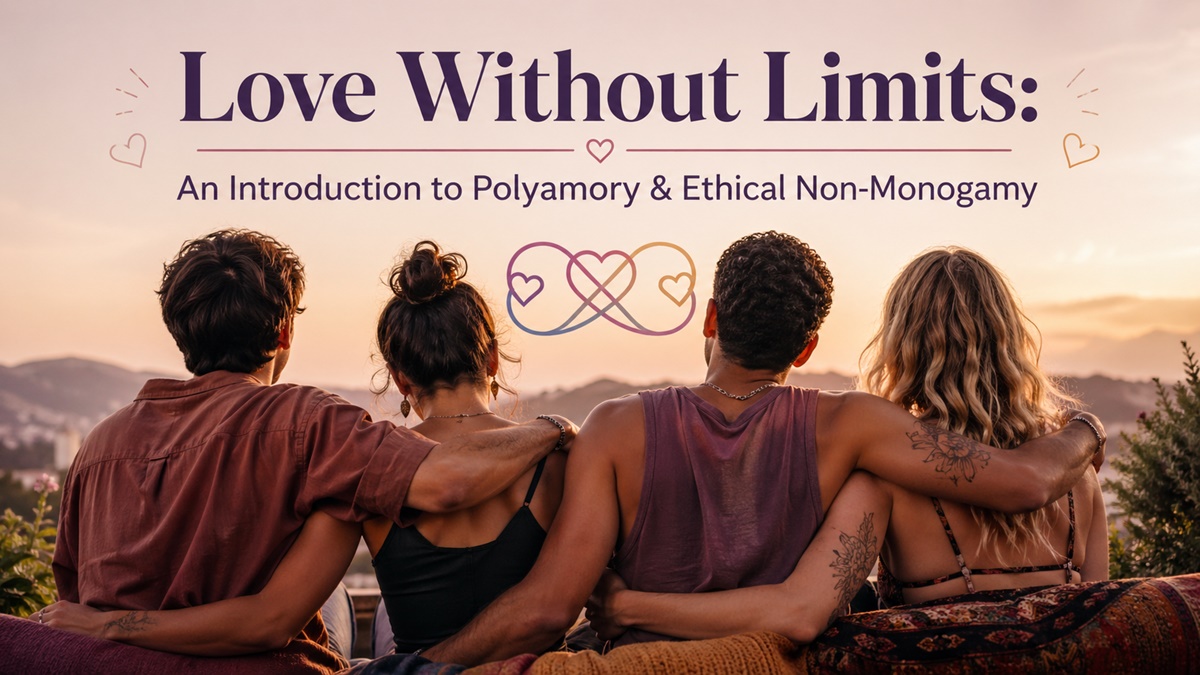
If you’ve been hearing the words “polyamory” and “ethical non-monogamy” more often lately — in conversations, on social media, in books and podcasts — you’re not imagining things. These relationship structures have moved from the fringes of conversation into the mainstream, and with good reason: for a lot of people, they represent a more honest and intentional way of building connections.
But with visibility comes confusion. Terms get used interchangeably when they shouldn’t. Misconceptions circulate. And for someone who’s genuinely curious, it can be hard to know where to start.
This article is that starting point. It’s written for the curious — people who are wondering what these relationship styles actually involve, what the landscape of terminology looks like, what the real challenges are, and where to find good resources if they want to go deeper. We’ll cover all of that, and we’ll do it with the same values that guide everything at The LoftNC: education, honesty, and respect.
And yes — we’ll also talk about our monthly Poly & ENM Lifestyle Discussion, because this article is a companion to that space.
November 2026

Poly & ENM Lifestyle Discussion
1. What Is Ethical Non-Monogamy?
Ethical Non-Monogamy (ENM) is an umbrella term for any relationship structure in which all involved parties have given informed, ongoing consent to engage in romantic or sexual relationships with more than one person. The word “ethical” is load-bearing here: it distinguishes these structures from cheating, which involves deception, and from coercion, which violates consent.
ENM is not a single thing. It’s a category — a family of relationship styles that share a commitment to transparency and consent but differ significantly in structure, intent, and practice. Polyamory is one of the most well-known forms, but it’s far from the only one.
The core principles that underpin all ethical non-monogamous relationships, regardless of their specific form, are: informed consent (everyone involved knows and agrees to the arrangement), honesty (open communication about needs, boundaries, and feelings), autonomy (each person retains their own agency and voice), and ongoing communication (agreements are not static — they evolve as people and circumstances change).
None of this is simple. But that’s actually the point: ENM relationships often require more intentional communication and self-awareness than many monogamous relationships, not less.
2. The Landscape: Types of ENM Relationships
Understanding the terminology can feel overwhelming at first — the community has developed a rich vocabulary for describing relationship structures with precision. Here’s a working guide to the most commonly encountered terms and styles.
2.1 Polyamory
Polyamory — from the Greek and Latin for “many loves” — refers to having multiple romantic relationships simultaneously, with the knowledge and consent of everyone involved. The emphasis is on emotional intimacy and lasting connection, not just sexual variety. People who identify as polyamorous (often called “poly”) may be in relationships that are deeply committed, long-term, and family-like in structure.
Polyamory exists on a wide spectrum. It can look like a person with two long-term partners who know and respect each other. It can look like a close-knit network of interconnected relationships. It can be highly structured or relatively fluid. The common thread is consent, communication, and genuine emotional investment.
2.2 Key Glossary of Terms
Below is a reference glossary of the terms you’re most likely to encounter in poly and ENM communities. This is not exhaustive — the community continues to develop language — but it covers the foundation.
| Term | What It Means |
|---|---|
| Polyamory | Multiple loving, romantic relationships with the knowledge and consent of all involved. Emotional intimacy is central. |
| Metamour | Your partner's other partner. Someone you are connected to through a shared partner, even if you don't have a direct romantic relationship with them. |
| Polycule | The extended network of people connected through polyamorous relationships. May include partners, metamours, and their partners. |
| Hierarchical Poly | A structure in which relationships are ranked, often with a "primary" partner receiving more time, resources, and priority than "secondary" or "tertiary" partners. |
| Non-Hierarchical Poly | A structure in which no one partner is formally ranked above another. Each relationship is valued on its own terms. |
| Kitchen Table Poly | A style in which all partners and metamours are encouraged to know each other, socialize, and be part of a shared community. The name evokes the image of everyone sitting together at the kitchen table. |
| Parallel Poly | A style in which partners maintain separate, parallel lives that don't significantly intersect. Partners may know of each other but don't interact socially. |
| Solo Poly | A polyamorous approach in which the individual prioritizes their own autonomy and does not seek to entangle their lives with partners through shared living, finances, or formal commitment structures. |
| Anchor / Nesting Partner | Terms for a deeply committed partner, often (but not always) one with whom you share a home or life logistics. Used as alternatives to "primary" in non-hierarchical contexts. |
| Open Relationship | A relationship — typically a committed couple — that permits sexual (and sometimes romantic) involvement with others outside the partnership. Structures vary widely. |
| Swinging | A practice typically involving couples who engage in consensual recreational sexual activity with other couples or individuals. The focus is generally sexual rather than romantic. The existing relationship remains primary. |
| Monogamish | Coined by author Dan Savage, this describes relationships that are primarily monogamous but allow for occasional, agreed-upon outside sexual activity. |
| Relationship Anarchy | A philosophy that rejects predefined relationship hierarchies and labels. Connections are defined by the people in them, not by social norms or conventional categories. Friendship and romance are not ranked differently. |
| Queerplatonic (QPR) | A relationship with a level of commitment and closeness that exceeds typical friendship, but which is not necessarily romantic or sexual. Important in ENM and queer communities. |
| NRE | New Relationship Energy. The excitement, intensity, and idealization that often accompanies a new connection. Can be intoxicating and can affect judgment if not managed with awareness. |
| Compersion | The feeling of joy or happiness one experiences when a partner experiences joy in another relationship. Sometimes described as the opposite of jealousy, though the two can coexist. |
| Jealousy | A natural human emotional response that arises in ENM relationships just as in monogamous ones. In ENM communities, jealousy is treated as information to be explored, not a reason to shut down. |
| Polysaturated | The state of having as many relationships as one can healthily sustain. Someone who is polysaturated is not currently looking for new connections. |
| DADT | Don't Ask, Don't Tell. An arrangement in which a partner is permitted to have outside relationships but doesn't share details. Controversial in ENM communities due to concerns about informed consent. |
| Unicorn | A bisexual person (often a woman) sought by an existing couple to join them as an equal third partner. The term reflects how rare this ideal is — and can carry critical undertones about how such arrangements often play out. |
| Unicorn Hunting | The practice of a couple searching for a third partner to fit their specific vision. Critiqued when it treats the third as a resource to serve the couple rather than as an equal participant with their own needs. |
3. How ENM Structures Differ From Each Other
A common misconception is that all non-monogamous relationships are essentially the same — that ENM is just “open relationships” by another name. In practice, the differences between structures are meaningful.
Swinging and polyamory, for example, often exist with different goals. Swinging is typically recreational and sexual in focus — the primary partnership remains central, and outside encounters are bounded. Polyamory, by contrast, is built around the possibility of genuine emotional intimacy with multiple people simultaneously. Someone might identify as a swinger and not polyamorous, or vice versa, or both.
Relationship anarchy differs from both: it rejects the hierarchies and frameworks that even many poly relationships maintain. A relationship anarchist doesn’t distinguish between “primary” and “secondary” partners, and may not distinguish sharply between deep friendship and romantic partnership.
Kitchen table polyamory and parallel polyamory offer two different answers to the question of how interconnected partners’ lives should be. Neither is superior — they suit different personalities and circumstances.
What matters is that the structure chosen genuinely reflects the needs and agreements of the people involved — not what they think they’re supposed to want, or what looks good on paper.
4. Consent, Communication & Agreement Structures
If ENM has a foundation, it’s this: the agreements people make with each other, and the ongoing communication required to honor them.
Agreements, Not Rules
In ENM communities, there’s often a distinction made between “rules” and “agreements.” Rules tend to be unilateral — one partner sets them to limit the other’s behavior, often out of insecurity or a desire for control. Agreements are mutually created, mutually agreed to, and mutually revisable. The distinction matters because agreements respect everyone’s agency; rules often don’t.
Agreements in ENM relationships might cover things like: safer sex practices, disclosure expectations (who to tell, when, and how much detail), how to handle scheduling conflicts, how to introduce new partners to existing ones, and what to do when feelings arise that weren’t anticipated.
The Role of Ongoing Consent
Consent in ENM isn’t a one-time conversation. People change, relationships evolve, and feelings that weren’t present a year ago may be present now. What works for a couple at the beginning of their ENM journey may not work three relationships later. Checking in regularly — not just when there’s a problem — is part of how healthy ENM relationships sustain themselves.
Safer Sex in ENM Contexts
Fluid bonding — having unprotected sex with a specific partner by mutual agreement — is a concept that arises frequently in ENM relationships. These agreements require honest communication about testing history, current partners, and risk tolerance. Regular STI testing and transparent disclosure are widely considered ethical obligations, not optional courtesies, in ENM communities.
5. Common Pitfalls & Obstacles
Ethical non-monogamy is not a cure for relationship problems. In fact, many people discover that the communication and self-awareness it requires will surface existing issues faster than they expected. Here are the challenges that come up most often — and what to know about them.
5.1 Using ENM to Fix a Broken Relationship
One of the most common mistakes people make is entering non-monogamy as an attempt to repair or rescue an existing relationship that is already in trouble. The idea is that adding new connections will reinvigorate what’s lost. In practice, non-monogamy tends to amplify existing dynamics — including broken ones — rather than resolve them. If a relationship has unresolved trust issues, poor communication, or one partner who isn’t genuinely on board, those problems will follow you into ENM.
5.2 One Partner Going Along Reluctantly
ENM that isn’t genuinely wanted by all parties isn’t ethical. Yet it’s surprisingly common for one partner to push for an open relationship while the other goes along out of fear of losing the relationship. This dynamic — sometimes called “consent under pressure” — rarely ends well. Authentic enthusiasm, or at minimum a genuine willingness to try, is the baseline. If someone is agreeing only because they feel they have no other option, that’s a signal worth taking seriously.
5.3 New Relationship Energy (NRE) and Its Effects
NRE is real, powerful, and can be genuinely destabilizing. The excitement of a new connection can cause people to deprioritize existing relationships, make promises they can’t keep, or lose perspective on what they’ve already built. Awareness of NRE doesn’t make it go away, but it does allow people to make more intentional choices while in the middle of it.
5.4 Jealousy
Jealousy doesn’t disappear in ENM relationships, and expecting it to is a setup for pain. In ENM communities, jealousy is generally treated not as a moral failing but as useful emotional information: a signal pointing toward an unmet need, a fear, or an insecurity that deserves attention. The goal is not to eliminate jealousy but to respond to it thoughtfully — to ask what it’s telling you, and to communicate that to your partner rather than act from it reactively.
Compersion — the joy of seeing your partner happy with someone else — is real, but it doesn’t arrive automatically. For many people, it develops over time, and some people experience jealousy and compersion simultaneously.
5.5 Time and Energy Management
Multiple relationships mean multiple people with needs, schedules, and emotional investments. The logistical demands of polyamory in particular can be significant — especially for people with children, demanding careers, or health considerations. “Polysaturation” is a real phenomenon: reaching the point at which you genuinely cannot give more of yourself to new connections without neglecting existing ones. Recognizing that limit is a form of self-care and relationship care.
5.6 Communication Overload and Processing Fatigue
ENM communities tend to place a very high value on communication — sometimes to a degree that can become exhausting. Constant check-ins, processing sessions, and emotionally intensive conversations are part of the landscape. For some, this is enriching. For others, it becomes a source of burnout. Finding a sustainable communication style is something many people have to actively work toward.
5.7 Social and Family Stigma
Non-monogamy is not yet widely understood or accepted in mainstream culture. People who practice ENM may face judgment from family, friends, religious communities, or coworkers. In some cases, there are real practical stakes: custody arrangements, employment in certain fields, or family relationships. Choosing how out to be, and to whom, is a decision each person must make thoughtfully for themselves. The Charlotte area kink and ENM community offers a space where no one has to explain or justify themselves — but that doesn’t mean the outside world has caught up.
5.8 Prescriptive Community Norms
ENM communities, like all communities, can develop their own orthodoxies. There’s sometimes pressure to do non-monogamy the “right” way — the non-hierarchical way, the kitchen-table way, the relationship-anarchy way. None of those frameworks is universally correct. The structure that works is the one that genuinely fits the people involved, arrived at through honest reflection — not the one that earns the most approval from online communities or experienced practitioners.
6. Is ENM Right for You? Questions Worth Asking
There’s no personality test or checklist that determines whether someone is “suited” for ethical non-monogamy. But there are honest questions that are worth sitting with before or during the process of exploring it.
- Are you interested in ENM because it genuinely appeals to you, or because you’re trying to solve a problem in an existing relationship?
- If you have a partner, are both of you genuinely interested — or is one of you going along for the other’s sake?
- How do you generally handle jealousy, uncertainty, and emotional complexity?
- Are you prepared to do significant communication work — not just at the beginning, but ongoing?
- Do you have the time and emotional bandwidth for more than one relationship right now?
- What does a successful outcome look like to you? What does a failed one look like?
- Are you coming to ENM from a place of abundance — wanting to share love — or from a place of lack — trying to fill something that’s missing?
There are no right or wrong answers to these questions. But the clarity they can produce is valuable, regardless of what you decide.
7. Resources for Going Deeper
If this article has sparked genuine curiosity, the following resources are widely respected starting points in ENM and polyamory communities. They represent a range of perspectives and approaches.
Books
- The Ethical Slut by Dossie Easton & Janet Hardy — A foundational text in ENM culture. Readable, warm, and comprehensive. Now in its third edition.
- Polysecure by Jessica Fern — Explores attachment theory in the context of polyamorous relationships. Excellent for people who want to understand the psychological dimensions of ENM.
- More Than Two by Franklin Veaux & Eve Rickert — A detailed exploration of polyamory. Note: the authors’ subsequent personal history has generated controversy; the book’s content remains widely discussed in ENM communities.
- Designer Relationships by Mark A. Michaels & Patricia Johnson — Explores intentionally designed relationship structures beyond the default.
- Redefining Our Relationships by Wendy-O Matik — A shorter, accessible overview of relationship anarchy and alternatives to conventional relationship models.
Online Communities & Resources
- r/polyamory (Reddit) — Large, active community with a wide range of experience levels. Good for questions, shared experience, and perspective.
- PolyamoryWeekly.com / Podcast — Long-running podcast covering polyamory topics in accessible, conversational format.
- More Than Two website (morethantwo.com) — Extensive written resources on polyamory topics.
- Loving More (lovemore.com) — One of the earliest organizations supporting polyamorous people in the U.S.
- FetLife groups — If you’re already on FetLife, search for poly and ENM groups in your area. The Charlotte and Gaston County areas have active presence.
Therapy & Support
- AASECT-certified therapists (aasect.org) — The American Association of Sexuality Educators, Counselors and Therapists maintains a directory of professionals trained in sexuality and relationships. Look for therapists with ENM/polyamory experience specifically.
- Psychology Today therapist finder — Filter by “open relationships” or “polyamory” to find local therapists with relevant experience.
- OpenPath Collective — Sliding-scale therapy options for those concerned about cost.
8. The LoftNC Poly & ENM Lifestyle Discussion
The concepts in this article come to life in conversation. That’s why The LoftNC hosts a monthly Poly & ENM Lifestyle Discussion — a recurring gathering for people across the full spectrum of experience with ethical non-monogamy.
This is not a lecture or a class. It’s a facilitated discussion where people can ask real questions, share what they’ve learned, work through challenges, and connect with others who are navigating the same territory. Whether you’ve been in polyamorous relationships for a decade or you’re just starting to wonder if ENM might be for you, there’s a seat at the table.
What you can expect:
- A welcoming, judgment-free environment for honest conversation
- Participants across the experience spectrum — curious newcomers to experienced practitioners
- Topics drawn from participant questions and current community conversation
- Connection with the broader Charlotte-area ENM and kink community
- The LoftNC’s usual commitment to safety, consent, and community standards
⚠ Important Disclaimers
- Educational purpose only. This article is written for informational and educational purposes. It does not constitute relationship counseling, psychological advice, legal advice, or medical advice of any kind. The LoftNC and Lady Leigh are not licensed therapists, counselors, psychologists, or medical professionals.
- Not a prescription. Nothing in this article is intended to suggest that ethical non-monogamy is preferable to monogamy, or vice versa. Relationship structures are personal. The goal here is to inform, not to advocate for any particular way of living.
- Individual variation. All relationship dynamics, emotional responses, and personal experiences are individual. What works for one person or partnership may not work for another. General descriptions of ENM structures are necessarily simplified and should not be taken as definitive.
- Seek qualified support. Individuals experiencing significant relationship distress, mental health challenges, or concerns about consent or safety are encouraged to seek support from a licensed mental health professional with experience in sexuality and relationships.
- STI/health information. Any reference to sexual health practices in this article is general in nature. For specific guidance on safer sex, STI testing, and sexual health, please consult a qualified healthcare provider.
- Community standards apply. The LoftNC's events, including the Poly & ENM Lifestyle Discussion, are governed by our code of conduct and community standards. Participation requires adherence to those standards. Events are for adults only.
- Accuracy and currency. Relationship terminology and community norms evolve. While we make every effort to use language accurately and respectfully, the vocabulary of ENM communities continues to develop. If you encounter a term used differently in your community, your local usage is valid.
- External resources. Links and references to external books, websites, and organizations are provided as a convenience. The LoftNC does not endorse any specific external resource, therapist, or organization, and is not responsible for the content or quality of external sources.
A Final Word
The kink community and the ENM community overlap in meaningful ways — and one of the most important is a shared insistence on intentionality. Both require you to think clearly about what you want, communicate it honestly, and hold yourself accountable to the agreements you make. That’s not always comfortable. But it tends to produce relationships that are more honest, more resilient, and more genuinely fulfilling than the ones we fall into by default.
Whatever you’re curious about, whatever questions you’re sitting with, we hope you’ll bring them to the table. That’s what we’re here for.

Lady Leigh is the owner of The LoftNC and a regionally respected educator and leader in the BDSM/kink community, with decades of experience in safe practice, consent education, and community building in the greater Charlotte area.