
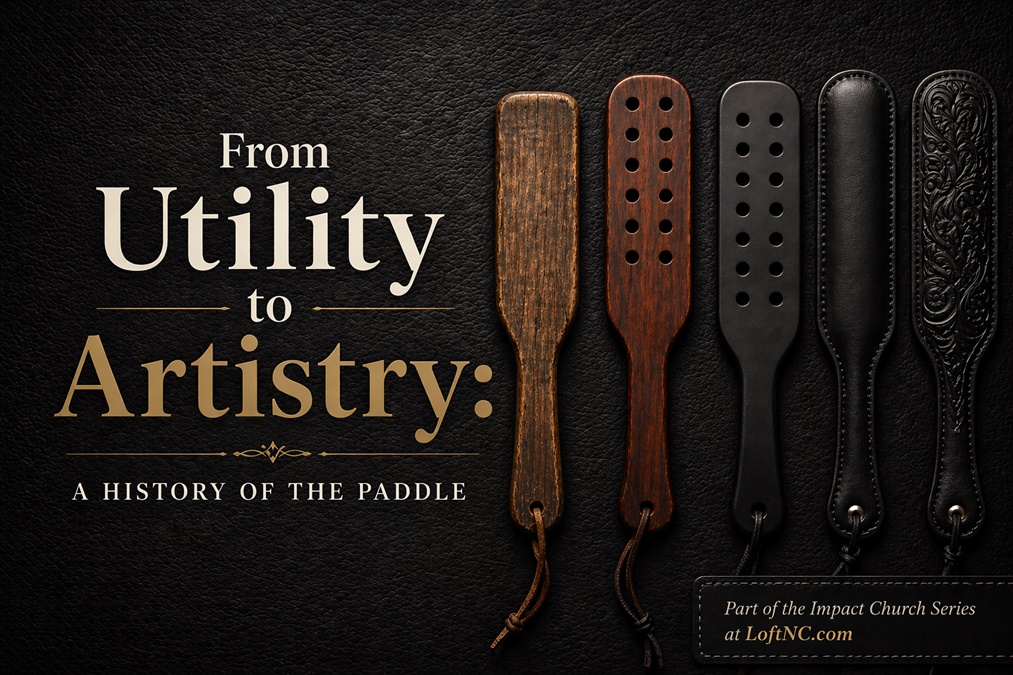
Whether you are a seasoned heavy-hitter or someone just entering the “Impact Church” for the first time, you’ve likely felt—or held—a paddle. But where did this staple of the dungeon come from?
The Origins of Impact
Long before they were crafted from exotic woods or medical-grade silicone, paddles were tools of utility. Their history is deeply rooted in domestic and institutional discipline, often used because they provided a “stern” correction without the immediate skin-breaking risk of a whip or a cane.
The Transition to the Scene
As the BDSM community began to formalize in the mid-20th century, the paddle evolved from a household object into a specialized implement.
The Material Revolution: We moved from simple “kitchen-counter” wood to materials like Lexan (for that distinct sting), leather (for a thuddy, heavy feel), and modern silicone.
Safety & Engineering: Early paddles were often heavy and unbalanced. Today’s designs prioritize the “ergonomics of the strike,” allowing Tops to maintain control and Bottoms to receive consistent sensation.
Choosing Your Implement
In this month’s “Impact Church” class, we aren’t just looking at the past; we are looking at the physics of the present.
Wood: Classic, rigid, and predictable.
Acrylic/Lexan: High-velocity and sting-focused.
Ventilated vs. Solid: Did you know those holes in a paddle aren’t just for decoration? They reduce air resistance, increasing the “sting” factor by allowing the paddle to move faster through the air.
Why It Matters
Understanding the history and construction of your gear is a core part of individual responsibility and integrity. When you know how a paddle is made, you know how it will react with your partner’s body—and that is the foundation of a safe, high-protocol scene.
History & Evolution of Paddles
| Era | Primary Materials | Purpose/Context |
| Pre-1950s | Wood, repurposed leather | Primarily domestic or institutional; rarely “designed” for play. |
| 1960s – 1980s | Heavy Oak, Pine, early Plastics | The rise of “Old Guard” dungeon culture; focus on heavy, rigid wooden paddles. |
| 1990s – 2000s | Lexan, Acrylic, Carbon Fiber | Introduction of high-tech materials. This era focused on the “Sting vs. Thud” distinction. |
| 2010s – Present | Silicone, Medical-Grade Polymers | Focus on hygiene (non-porous materials), ergonomics, and aesthetic artistry. |

Lady Leigh is the owner of The LoftNC and a regionally respected educator and leader in the BDSM/kink community, with decades of experience in safe practice, consent education, and community building in the greater Charlotte area.